
Blog Songket Fundamentals
Traditional Songket: What Defines the Classic Style
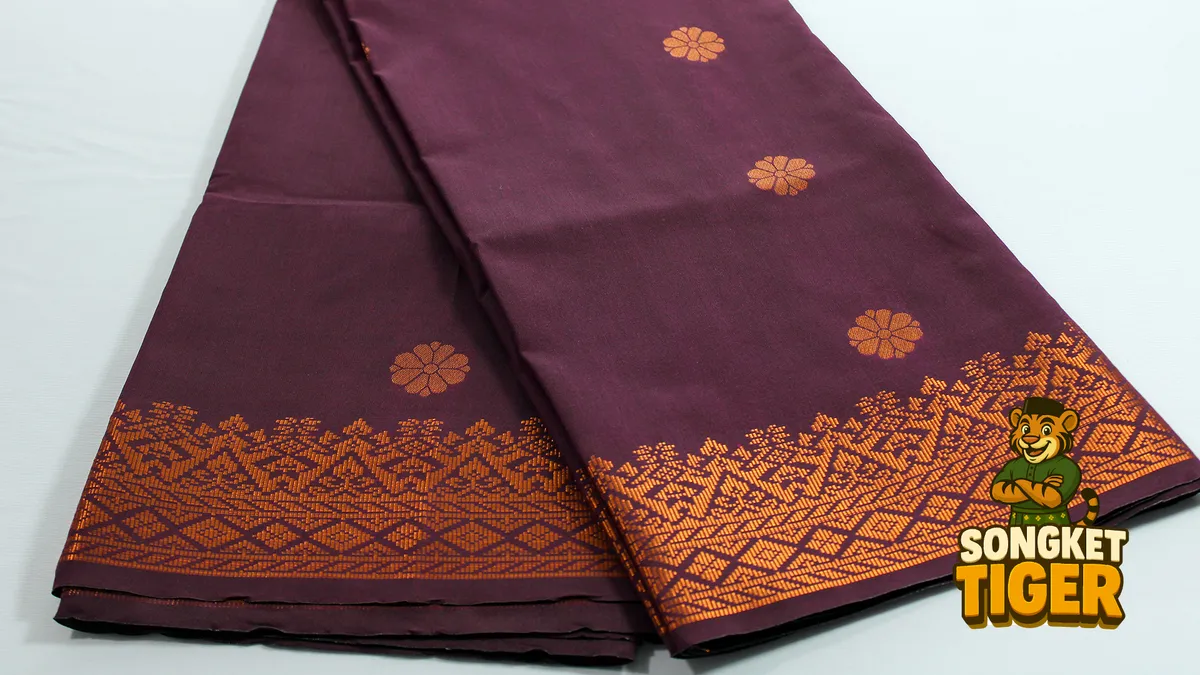
When people picture songket, they’re usually picturing traditional songket — the dense, richly patterned fabric associated with royal courts and formal weddings. It’s still one of the two dominant design directions in songket today, alongside modern songket, and it’s worth understanding what actually defines “traditional” beyond just “old-looking.”
Classic, Established Motifs
Traditional songket draws almost exclusively from the established motif vocabulary passed down through generations — bunga tabur, pucuk rebung, bintang beralih, and similar long-recognized patterns — rather than newer or simplified reinterpretations. The motifs themselves aren’t necessarily more numerous in a traditional piece, but they follow conventional forms rather than contemporary variations.
Denser, Fuller Pattern Coverage
Traditional pieces tend to favor fuller, more continuous pattern coverage across the fabric — dense borders, elaborate end panels, and in many cases full-field coverage — rather than the more open, minimal spacing common in modern designs. This connects directly to the pattern structure concepts of field, border, and end panel, all typically worked at maximum density in a traditional piece.
Classic Colour Palettes
Traditional songket generally favors a specific, time-tested set of base colours — deep reds, blacks, dark greens, royal blues, and maroons — paired with gold or silver thread, rather than the pastel or muted earth-tone palettes that have become popular in more contemporary songket. These classic combinations are chosen partly for how strongly they contrast with and set off the metallic thread. See songket colors and their meanings for more on why specific colours are favoured.
Heavier Fabric Weight
Because traditional songket typically uses denser weaving and fuller metallic coverage, the finished fabric tends to be noticeably heavier than lighter, modern alternatives. This isn’t a flaw — it’s part of the visual and tactile impression traditional songket is meant to create — but it’s worth knowing if comfort over a long ceremony is a priority, in which case a lighter bordered or modern piece may suit better.
Where Traditional Songket Is Still the Default Choice
Despite the growth of modern styles, traditional songket remains the default, expected choice for the most formal ceremonial occasions — bridal wear in particular, along with official state functions and formal cultural performances. It’s the style most closely tied to the fabric’s original ceremonial and royal history.
Frequently Asked Questions
Is traditional songket always handmade? Not necessarily — both handwoven and machine-woven production can follow traditional motif and colour conventions. “Traditional” describes the design style, not the production method; see is songket handmade or machine-made?
Is traditional songket more expensive than modern songket? Often yes, mainly because traditional designs tend to use denser, fuller pattern coverage, which requires more metallic thread and weaving time — but the price gap depends more on density and fabric base than on “traditional” vs “modern” as a label alone.
Can traditional and modern elements be combined in one piece? Yes — many contemporary designers blend classic motifs with lighter, more open spacing, sitting somewhere between the two categories rather than strictly in one or the other.
If dense, classical patterning in time-honoured colours and motifs is what you picture when you hear “songket,” traditional songket is exactly that — and it remains the reference point every modern variation is still measured against.