
Blog Songket Fundamentals
Songket Motifs and What They Mean
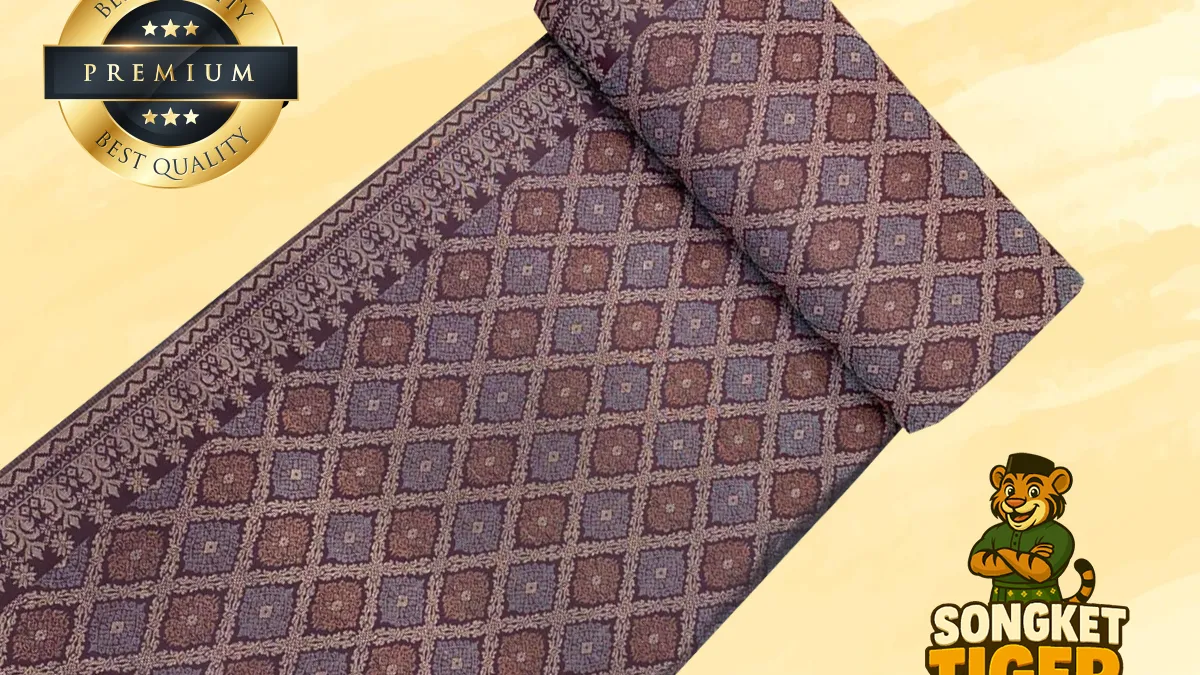
Songket motifs aren’t chosen at random — they’re a shared visual vocabulary, drawn largely from nature and passed down through generations of weavers, with each shape carrying its own meaning. Recognizing a handful of the most common motifs is one of the most useful skills a buyer can pick up, since it turns a piece of songket from “pretty pattern” into something you can actually read.
Bunga Tabur (Scattered Flower)
One of the most recognizable and widely used motifs, bunga tabur translates roughly to “scattered flower.” Small floral shapes are spread evenly across the fabric field, generally associated with elegance, femininity, and a sense of abundance. It’s a common choice for bordered and lighter-coverage songket precisely because it works well spaced out rather than densely packed.
Pucuk Rebung (Bamboo Shoot)
Pucuk rebung depicts the triangular shape of a young bamboo shoot, and it’s one of the most enduring motifs across Malay-world textile traditions generally, not just songket. Symbolically, it’s associated with growth, resilience, and new beginnings — fitting themes for garments worn at weddings and other life milestones. You’ll often see it used along borders and end panels rather than scattered through the main field.
Bintang Beralih (Shifting Star)
A geometric star-based motif, bintang beralih (“shifting” or “moving star”) is associated with guidance and hope — themes tied to the star’s role as a fixed point for navigation historically. It tends to appear in more geometric, structured pattern layouts rather than the softer, organic curves of floral motifs.
Bunga Cengkih and Other Floral Variants
Beyond bunga tabur, songket draws on a wide range of specific floral references — bunga cengkih (clove flower) and others — each a distinct decorative unit rather than a generic “flower shape.” Weavers and regional traditions often favor particular floral motifs, which is part of what gives different regions’ songket its own visual signature; see regional songket styles in Malaysia for more on this.
Geometric and Diamond Motifs
Alongside floral and organic shapes, songket also uses purely geometric motifs — diamonds, lattice grids, and repeating angular patterns — often seen in full-weave songket where a continuous, structured field pattern is needed across the entire cloth.
How Motifs Combine Into a Finished Piece
A single piece of songket rarely uses just one motif in isolation — motifs are typically layered, with a primary field motif, a distinct border motif, and often a more elaborate end-panel (kepala) motif combined into one coherent composition. Understanding the pattern structure these motifs sit within helps make sense of why a piece looks the way it does as a whole, not just motif by motif.
Frequently Asked Questions
Do motifs have fixed, universally agreed meanings? Broadly yes for the most established motifs (bunga tabur, pucuk rebung, bintang beralih), though interpretations can vary slightly by region and weaving community, since this is an oral and craft-based tradition rather than a single codified text.
Can motifs be mixed within one piece? Yes — combining a field motif with a different border and end-panel motif is standard practice, not an exception.
Are new motifs still being created? Yes — contemporary and modern songket designs sometimes introduce simplified or reinterpreted versions of classic motifs, or occasionally new geometric patterns, while still working within the broader visual language of the tradition.
Once you can identify bunga tabur, pucuk rebung, and bintang beralih on sight, you’ll start noticing them everywhere — and you’ll have a genuine head start on understanding what makes one piece of songket different from another.