
Blog Songket Fundamentals
Songket Patterns Explained: How to Read a Woven Design
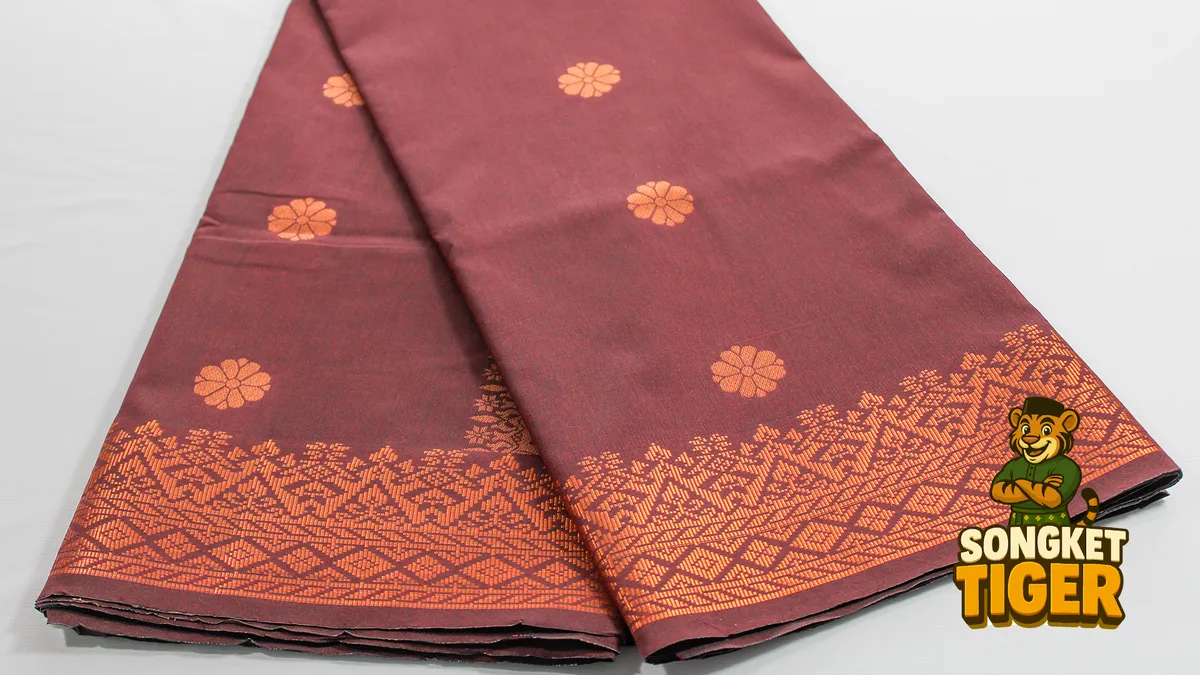
Songket motifs get most of the attention, but the pattern — how those motifs are arranged across the fabric — is just as important to understand. Pattern and motif are related but different concepts: a motif is a single decorative unit (a flower, a shoot, a star), while the pattern is the overall structure that repeats, spaces, and combines motifs across the cloth.
Scattered vs Structured Layouts
Broadly, songket patterns fall into two layout families:
- Scattered (bertabur) layouts place individual motifs at regular intervals across an otherwise plain background, creating a “sprinkled” effect. This is a lighter, more restrained look often used on bordered songket or more everyday-formal pieces.
- Dense, continuous layouts interlock motifs edge-to-edge with little or no plain background visible, typical of songket tenun penuh, where the entire surface is patterned.
Border, Field, and End-Panel Structure
Traditional songket layout is usually organized into distinct zones, each of which may carry a different treatment:
- The field — the main body of the fabric, which may be plain, lightly scattered, or fully patterned depending on the type.
- The border — a dedicated decorative strip running along one or both long edges, often the most densely worked part of the piece.
- The end panel (kepala) — a distinct, usually more elaborate section at one or both ends of the cloth, which becomes a focal point when the fabric is worn or draped.
Recognizing these three zones is the fastest way to judge a piece of songket’s overall structure at a glance, before even considering which specific motifs are used.
Repetition and Symmetry
Songket patterns are built almost entirely from repetition — a single motif unit repeated at consistent intervals, often in symmetrical rows or a grid, rather than a single large illustrative scene. This isn’t a limitation of the technique; it’s a deliberate aesthetic rooted in the discipline of the weave itself, where each motif segment has to be counted and picked by hand (or, in modern production, programmed into a mechanical loom) with precision.
Density as a Signal of Formality and Cost
As a rule of thumb, the denser and more continuous the pattern, the more formal — and typically the more expensive — the piece, since more metallic thread and weaving time go into it. This is one of the clearest visual cues for judging where a piece of songket sits on the formality scale before you even check the price tag. We explore this further in why songket is a luxury fabric.
Frequently Asked Questions
What’s the difference between a pattern and a motif? A motif is one individual decorative unit — a specific flower, shoot, or star shape. A pattern is how those motifs are arranged and repeated across the fabric as a whole. See songket motifs for a breakdown of the individual units themselves.
Are songket patterns always symmetrical? Almost always, yes — symmetry and consistent repetition are core to the aesthetic and to the practical mechanics of counted weaving.
Does a denser pattern always mean better quality? Not necessarily “better,” but it usually does mean more labour and material went into the piece, which is reflected in price. Quality also depends on weaving neatness and thread consistency — see our terminology glossary for related quality-related terms.
Once you can spot the field, border, and end panel, and recognize scattered versus dense layouts, you’re reading songket the way an experienced buyer does — before ever needing to identify a single specific motif.