
Blog Songket Fundamentals
The Origins of Songket: Where Did This Fabric Really Come From?
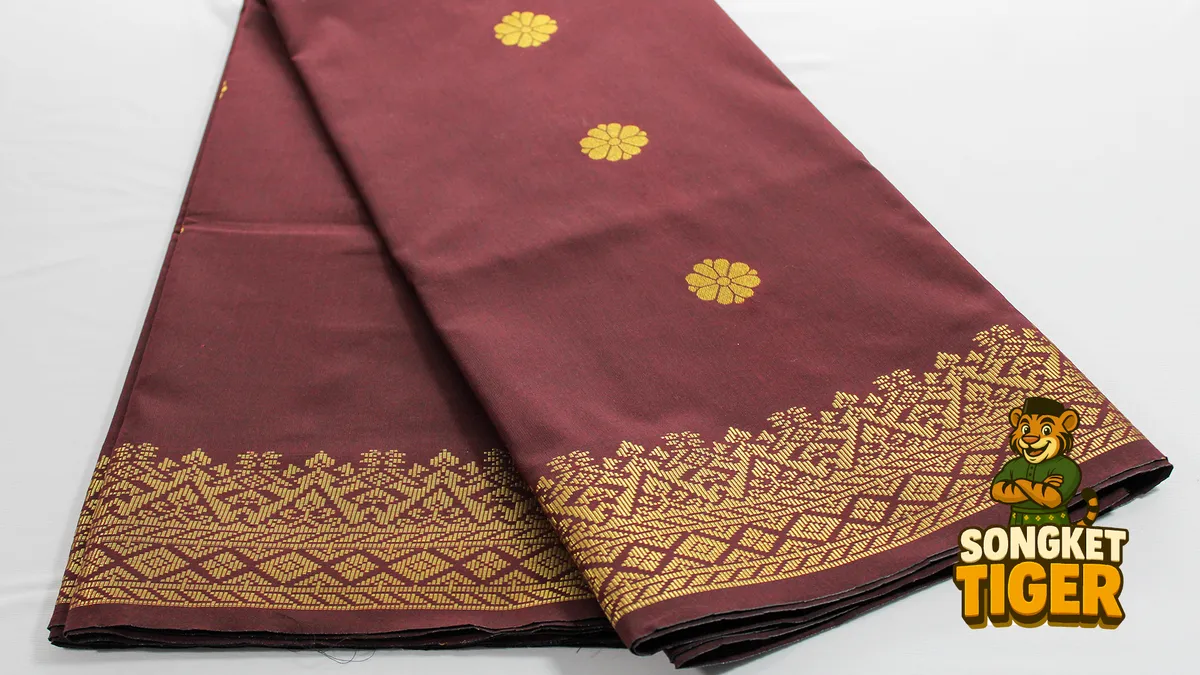
Ask five people where songket originated and you may get five slightly different answers — Palembang, the wider Sumatran coast, the Malay Peninsula, or a shared regional development with no single point of origin at all. The honest answer is that songket’s origins are genuinely debated, and that’s worth understanding rather than glossing over, because it says something true about how the craft actually spread.
The Palembang Theory
The most commonly cited origin point is Palembang, in South Sumatra, once the seat of the historic Srivijaya trading empire. Palembang sat at the crossroads of major maritime trade routes linking China, India, and the Middle East, and it’s this position — not just isolated local invention — that most historical accounts lean on to explain why songket developed there specifically. A busy trade port had reliable access to imported silk and metallic thread, plus the wealth of a royal court willing to commission luxury textiles. Those two conditions together are close to a checklist for where a fabric like songket could emerge.
Why Trade Matters as Much as Geography
It’s tempting to think of songket’s origin as a single “invention” moment, but the more accurate picture is a gradual fusion: an existing local weaving tradition absorbed new imported materials and technique influences over time. Chinese silk, and thread-wrapping and metallic-weaving techniques associated with Indian and Middle Eastern trade, are widely credited as key external inputs. Local weavers didn’t just copy these — they integrated them into supplementary weft weaving, a technique already used in the region for other patterned textiles, to create something new. This is part of why our history of songket piece frames it as evolution rather than a single invention.
Multiple Regions, Shared Lineage
Because trade networks connected the whole Malay world, not just one port city, songket-like weaving traditions took root in several places roughly in parallel — coastal Sumatra, the Malay Peninsula (notably Terengganu and Kelantan in present-day Malaysia), and Brunei all developed their own songket traditions with distinct motifs and conventions, while clearly belonging to the same broader family of textile. We cover how these regional traditions differ today in regional songket styles in Malaysia, songket in Indonesia vs Malaysia, and songket in Brunei.
Why the Debate Doesn’t Really Matter for Buyers
If you’re buying or wearing songket today, the precise origin story is interesting but not decisive — what matters more is understanding which regional tradition a specific piece follows, since that affects the motifs, the weave density, and the occasions it’s traditionally worn for. Our guide to songket motifs is a good next step if you want to start reading a piece of songket the way a weaver would.
Frequently Asked Questions
Is songket originally Indonesian or Malaysian? Both countries have deep, genuine songket traditions, and the honest historical position is that the craft developed across a connected Malay world rather than within one modern national border — those borders didn’t exist when the tradition took shape.
Does the origin affect the quality of songket today? Not directly — quality comes down to the weaver’s skill, the materials used, and the weaving density, not the region alone. That said, different regions do have reputations for particular motifs and styles, which we cover in types of songket.
The takeaway: songket wasn’t born in a vacuum, and it wasn’t born in only one place. It’s the product of a trade-connected region sharing and refining a technique over a very long time — which is exactly why so many different communities today rightfully claim it as part of their heritage.